When the hardest days come, you do not have to leave home.
H.E.A.R.T. Veterinary Services brings hospice care, pain relief and gentle in-home euthanasia to families across Vancouver Island. Dr. Kimberly Atkinson-Spinks comes to you, so your pet can stay on the bed, the couch or the patch of sun they chose for themselves years ago.
Wherever you are in this, there is a place to begin.
Families reach us at very different moments. Some are frightened by something that changed overnight. Some have known for weeks and cannot say it out loud. Some are planning quietly, long before anything is wrong. Choose whichever sounds most like today.

Something has changed and I am worried
Pain, appetite, breathing and mobility can shift quickly in an older pet. A palliative visit often steadies things and buys real, good time.
How to read the signs
I think it may be time
A quality of life consultation, or a peaceful goodbye at home whenever you decide you are ready. Nothing is hurried, and no one will push you.
What a visit is like
I want to plan ahead
Many families call months early, simply so they know who to phone and what it will cost. There is no obligation and no pressure.
See pricing and options

The last car ride is the part families remember.
A clinic is a hard place to say goodbye. There is a waiting room, a stainless table, and the smell that has always meant something is wrong. Most pets tell us plainly how they feel about it.
At home, a cat can stay under the bed if that is where she feels safest. A dog can lie on the deck with his family around him. There is no lobby, no clock, and no one waiting for the room. After twenty seven years of doing this work in people's homes, Dr. Atkinson-Spinks is certain it is the kinder way.
Comfort, compassion and peace, right at home.
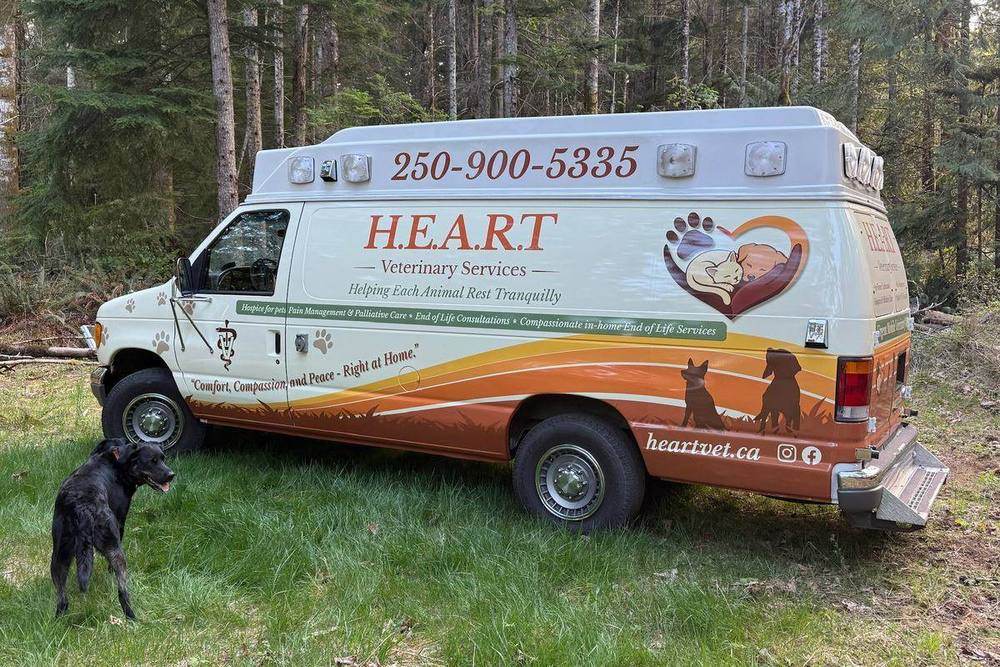
H.E.A.R.T. travels the corridor from Ladysmith to Campbell River in a fully equipped mobile unit, so everything needed for a visit arrives at your door. There is no waiting room and no car ride at the end of it.
If you have booked a visit, this is what will pull up outside.
Hospice care begins long before the last day.
Hospice is not a single appointment. It is the months when your pet is still very much themselves and simply needs help to stay comfortable. That is where much of our work happens.

Acupuncture
Dr. Atkinson-Spinks is a Certified Veterinary Acupuncturist. Acupuncture is often useful for arthritis, back pain, nausea and weakness, including in pets who cannot tolerate some medications.

Cold laser therapy
A portable Companion laser travels to every visit. It is quiet, painless, and often helps stiff hips, sore joints and slow healing wounds within a few sessions.

Medication and herbs
Western pain protocols alongside traditional Chinese medicinal herbs when they suit the patient. The goal is always the same: more comfortable days, without a fog.
Working with your regular veterinarian. H.E.A.R.T. is a companion to your primary clinic, not a replacement for it. We are glad to send visit notes back to your veterinarian so everyone stays on the same page.
Twenty seven years, most of them spent in living rooms.
Dr. Kimberly A. Atkinson-Spinks is a graduate of the Washington State University College of Veterinary Medicine, a Certified Veterinary Acupuncturist, and a certified member of the International Association for Animal Hospice and Palliative Care. She helped found the Washington State University Pet Loss Hotline, which supported grieving families for two decades, and she has been doing in-home euthanasia for more than twenty seven years.
She has taught veterinary students, run a hospital in New York City, served as a medical director, and worked emergency shifts in Nanaimo and Seattle. H.E.A.R.T. is what she built when she decided to spend the rest of her career on the part of the work that matters most to her.
Our goal is not only to treat pain. It is to help each animal feel safe, supported and understood, and to help families make difficult choices with clarity and compassion.
Dr. Kimberly A. Atkinson-SpinksYou can call before you are ready to book.
Many families phone simply to ask what happens, what it costs, or whether it is too soon. That call is welcome, and it is free.